
Inward-Opening vs. Outward-Opening Doors: Why Firefighters Must Train for Both
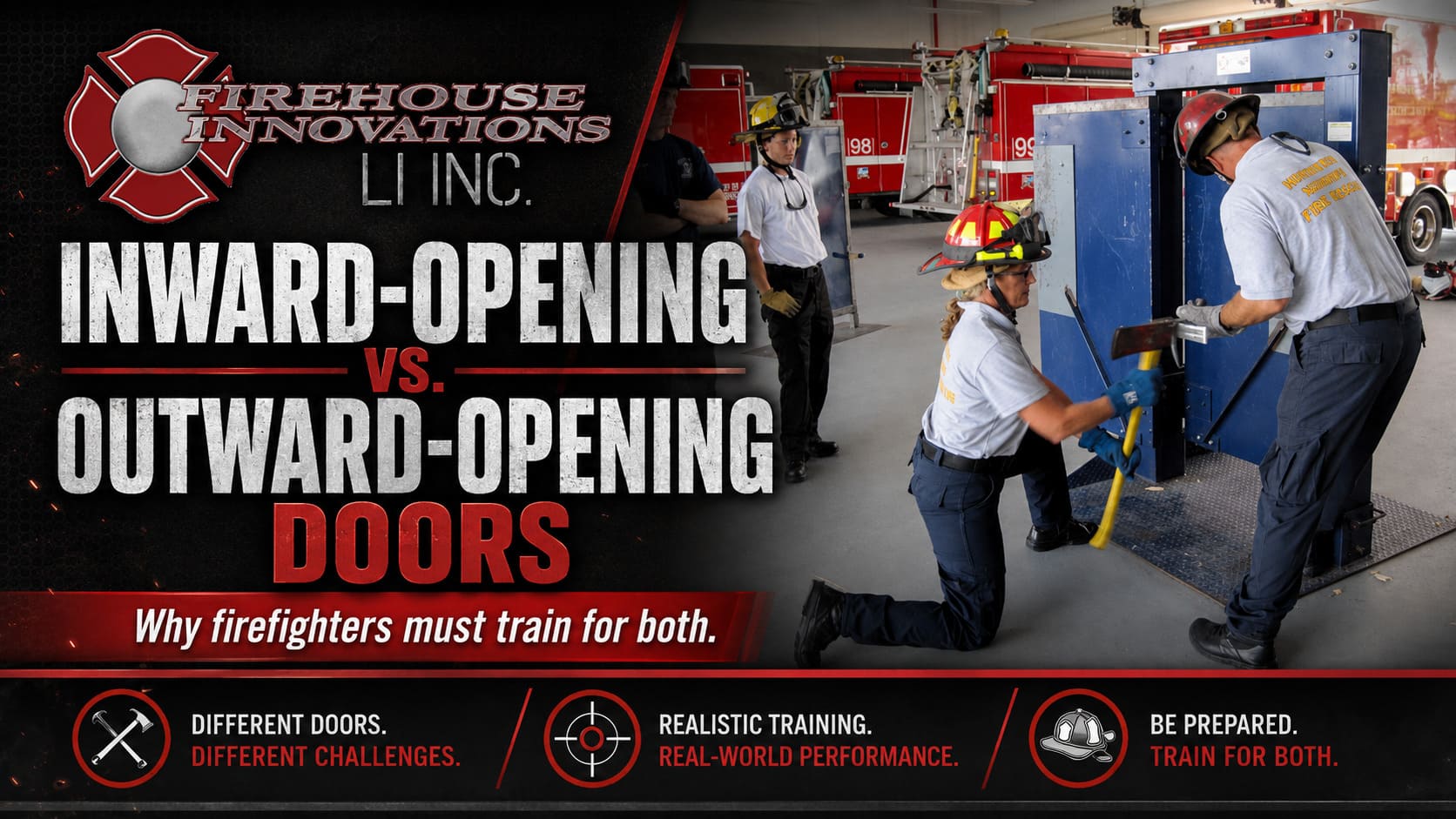
A locked door can appear simple from a distance. However, the direction in which it opens changes how firefighters approach the frame, position their tools, defeat the locking mechanism, and control the opening.
Inward-opening and outward-opening doors present different challenges. Firefighters who become comfortable with only one configuration may struggle when they encounter the opposite type under smoke, heat, noise, and time pressure.
For this reason, realistic forcible-entry training should include both inward- and outward-opening doors, along with different frames, reinforcements, locking conditions, and swing directions.
Why Door Size-Up Matters
Before forcing any door, firefighters should take a moment to examine it.
A door size-up may include:
- Checking visible hinges
- Looking at the frame and jamb
- Identifying the probable swing direction
- Locating locks
- Looking for security hardware
- Checking for angle iron
- Identifying drop bars or panic hardware
- Evaluating whether the door is metal or wood
- Looking for smoke, heat, or pressure
- Considering whether the door controls fire behavior
Visible hinges usually indicate that a door opens toward the firefighter. Hidden hinges generally suggest that it opens away, although building modifications and unusual hardware can complicate the assessment.
Firefighters should combine what they see with their understanding of the building occupancy.
Where Inward-Opening Doors Are Commonly Found
Inward-opening doors are often encountered in private residences, apartments, interior rooms, and other occupied spaces.
A typical inward-opening door rests against a stop within the frame. The locking mechanism extends from the door into the jamb.
Conventional forcible entry on an inward-opening door may involve creating a gap between the door and frame, setting the tool near the lock, and forcing the door away from the jamb.
However, the exact method depends on:
- Door construction
- Frame construction
- Lock strength
- Number of locks
- Security hardware
- Available working space
- Condition of the door
- Fire conditions behind it
A wooden residential door with a wood jamb may respond very differently from a reinforced apartment door with a metal frame and angle iron.
Where Outward-Opening Doors Are Commonly Found
Outward-opening doors are frequently installed at commercial occupancies, exterior exits, rooftop bulkheads, utility spaces, and locations where egress requirements influence door movement.
The hinges may be visible from the approach side. The door moves toward the firefighter rather than away.
Because the door rests differently within the frame, the gapping and forcing method used for an inward-opening door may not apply.
Firefighters may need to:
- Attack the latch or lock area from a different angle
- Create purchase between the door and frame
- Defeat carriage bolts or security hardware
- Address protected or inaccessible hinges
- Crush or deform part of a metal door
- Defeat an interior drop bar
- Use a through-the-lock or cutting method
- Select an alternate entry point
Training on actual outward-opening geometry is essential because tool movement and body position are not the same as they are on an inward-opening door.
Why One Training Door Is Not Always Enough
A prop that simulates only one door swing can limit the range of movements firefighters practice.
Even within the inward-opening category, left- and right-hand swinging doors require the firefighter to approach, gap, set, strike, and force from different positions.
A firefighter may have a stronger swing from one side. However, the emergency scene will determine the available position.
The Multi-Force Door System has two swinging doors, allowing firefighters to practice left- and right-hand configurations and the different gapping and spiking techniques associated with each side.
Balanced practice helps firefighters become less dependent on a single preferred stance.
Metal Frames Versus Wood Jambs
Door swing is only one factor. The frame material also influences the forcing operation.
Wood Jambs
Wood jambs are common in private dwellings. Depending on the construction, age, hardware, and condition, they may split, flex, or fail around the lock.
Firefighters should practice controlling the tool and reading how the material responds rather than relying on uncontrolled striking.
Metal Jambs
Metal frames are common in commercial and multifamily buildings. They may resist deformation and require more precise gapping and tool placement.
Additional security features can increase the challenge, including:
- Angle iron
- Multiple locks
- Reinforced strike areas
- Steel doors
- Drop bars
- Modified frames
- Security plates
Firehouse Innovations’ door system supports simulations involving inward-opening metal jambs, outward-opening metal jambs, wood jambs, and removable angle-iron features.
Training for Reinforced Doors
Some doors are specifically designed or modified to delay entry. Firefighters may encounter angle iron covering the lock area, reinforced steel edges, multiple locking points, or interior bars.
These conditions can prevent the tool from entering the normal position.
Training should teach firefighters to recognize reinforcement early and adjust instead of repeatedly striking the same ineffective location.
Possible alternatives include:
- Repositioning above or below the lock
- Creating a larger gap
- Defeating the reinforcement
- Using hydraulic tools
- Cutting specific components
- Attacking the hinges when appropriate
- Choosing another access point
The objective is to develop problem-solving skills, not merely physical force.
Preparing for Outward-Opening Metal Doors
Outward-opening metal doors can require specialized practice. In some situations, firefighters may need to crush the door edge to create enough room to place the tool behind the jamb.
An interior drop bar can add another challenge. Even after firefighters create a gap, the bar may prevent the door from opening.
Firehouse Innovations offers an Active Panel Crush Door Simulator with a drop-bar attachment. It is designed to temporarily replace one panel of an existing Multi-Force Door and lets firefighters practice crushing an outward-opening metal door edge, defeating a drop bar, and then forcing the locking area.
This creates a more realistic progression than practicing each movement separately.
Do Not Forget Door Control
Forcing the door is not the final step.
Once a door opens, it may change airflow and fire behavior. The crew should maintain control of the opening until the engine company, search team, or incident commander is ready for the next action.
Training should include:
- Maintaining control with a tool or strap
- Coordinating with the hoseline team
- Avoiding uncontrolled ventilation
- Communicating that the door is open
- Confirming whether the door needs to remain open or closed
- Preventing the door from relocking
- Protecting the entry team
Door control should be practiced during every scenario so that it becomes part of the forcible-entry process.
Include Hydraulic Tool Training
Conventional irons remain essential, but departments may also use hydraulic forcible-entry tools such as a Hydra-Ram or rabbit tool.
These tools require firefighters to create sufficient purchase, select a proper position, stabilize the device, and understand how the door and frame may move under pressure.
The Multi-Force Door is designed to accommodate both conventional and hydraulic forcible-entry training.
Departments should practice the transition from conventional tools to hydraulic methods so firefighters know when and how to change strategies.
Build Realistic Drill Rotations
A department can create a rotating schedule that exposes members to different conditions:
Drill One: Inward-opening wood-jamb door
Drill Two: Inward-opening metal-jamb door
Drill Three: Outward-opening commercial door
Drill Four: Left- and right-hand swing comparison
Drill Five: Reinforced angle-iron door
Drill Six: Hydraulic forcible entry
Drill Seven: Outward-opening crush and drop-bar scenario
Drill Eight: Full engine-company entry operation
Changing conditions keeps the program from becoming predictable and helps firefighters focus on door assessment.
Train for the Door You May Actually Encounter
Firefighters do not get to choose the door configuration during an emergency. They must work with the building, hardware, fire conditions, and available space in front of them.
Training on both inward- and outward-opening doors helps members understand the mechanical differences and become more adaptable.
Firehouse Innovations manufactures realistic forcible-entry training equipment for fire departments, academies, and public-safety organizations. To learn more about the Multi-Force Door, the Active Panel Crush Door Simulator, or hands-on training, call 631-390-9461 or request information online.
Sign Up For Product Announcements, Training Sessions, Tips & Tricks on Forcible Entry.
Important Links
Location
90 Remington Blvd.
Ronkonkoma, NY 11779