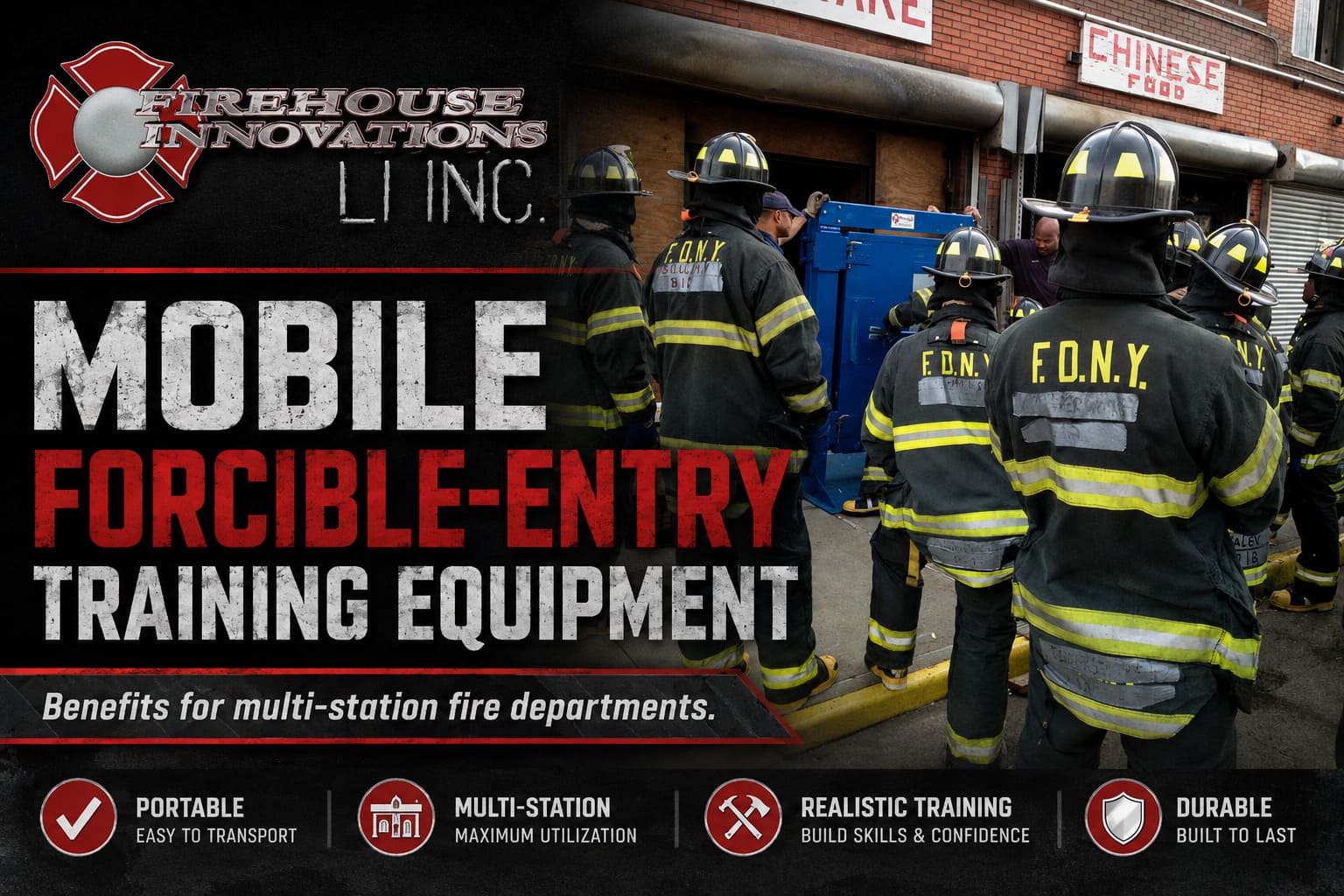
Fire departments want their training equipment to be realistic, durable, and available whenever members need to practice. However, many departments operate from multiple stations, serve large geographical areas, or share resources across a county, district, academy, or regional training network.
A stationary forcible-entry prop may be useful at one location while remaining unavailable to firefighters assigned elsewhere.
Mobile forcible-entry training equipment gives departments more flexibility. When a training door can be moved within a building, transported between stations, or shared with neighboring agencies, the department can increase the number of members who receive hands-on practice.
Firehouse Innovations developed a wheel system for its Multi-Force Door to make the training system easier to move while it remains upright. The attachment works with new and existing blue Multi-Force Door systems and can be installed or removed by one person.
The Challenge of Multi-Station Training
A department with several stations may face logistical problems when scheduling practical drills.
Members may work different shifts. Volunteer personnel may be available only during evenings or weekends. Some stations may lack a dedicated training area. Transporting every company to one central facility can reduce coverage or create scheduling conflicts.
These challenges can lead to inconsistent training.
One company may practice forcible entry frequently because the prop is stored at its station. Another may receive only occasional access.
Mobile equipment allows instructors to bring the drill to the firefighters rather than requiring every firefighter to travel to the equipment.
More Frequent Hands-On Practice
Forcible entry is a physical skill. Members need to practice tool placement, striking, body position, communication, door assessment, and control.
These skills improve through repetition.
A movable training door can support:
- Weekly company drills
- Monthly station rotations
- Recruit instruction
- Officer-development programs
- Train-the-Trainer sessions
- Mutual-aid exercises
- Countywide training events
- Public-safety demonstrations
- Skill-remediation sessions
- Pre-incident preparation
When equipment is easier to reposition, instructors may be more likely to incorporate it into shorter training sessions instead of waiting for a major annual event.
Sharing Equipment Across Several Firehouses
Budget limitations can make it difficult to purchase a full set of specialized training equipment for every station.
A mobile forcible-entry prop can serve as a shared departmental resource. The training division can establish a schedule and move the system from one firehouse to another.
For example:
- Station One receives the system for two weeks.
- Station Two receives it during the next rotation.
- The training academy uses it for the next recruit class.
- The system moves to a regional drill.
- It returns to headquarters for officer instruction.
This approach can increase the value of the department’s investment while giving more members access.
Easier Movement Within the Firehouse
Mobility is useful even when the prop never leaves the station.
Training floors and apparatus bays must remain functional. A large prop may need to be moved to create space for apparatus, maintenance, meetings, inspections, community events, or other drills.
Trying to drag or manually reposition heavy equipment can create unnecessary risk and may discourage regular use.
The Multi-Force Door weighs approximately 770 pounds when fully assembled. Firehouse Innovations’ removable wheel attachment is intended to let one person attach the system and move the door safely while it remains upright.
This allows the department to store the prop out of the way and bring it into the training area when needed.
Supporting Regional and Mutual-Aid Training
Fire departments rarely operate in isolation. Multiple agencies may respond together to structure fires, commercial incidents, technical rescues, and large-scale emergencies.
Regional training allows firefighters from different organizations to become familiar with one another’s procedures, terminology, and tool assignments.
A mobile training prop can be brought to:
- County fire academies
- Mutual-aid drills
- Firefighter conferences
- Regional training facilities
- Instructor workshops
- Recruit academies
- Public-safety campuses
- Department open houses
- Interagency exercises
Training together can improve communication and coordination before crews meet on an emergency scene.
Transporting the Multi-Force Door
Some heavy training props are difficult to relocate because they require specialized trailers or lifting equipment.
The Multi-Force Door can be disassembled into six primary parts: a base plate, two side jambs, a top header, and two doors. The system is designed to fit into a pickup truck or van, and Firehouse Innovations reports that it can be assembled or disassembled in approximately five minutes.
Departments can therefore use the wheel system for movement around the station and disassemble the prop when longer-distance transportation is necessary.
This combination supports both local mobility and transport between facilities.
Mobility Helps Keep Training Areas Organized
Training equipment that is difficult to move may remain in the same location even when it interferes with other operations.
A movable door system can help a department maintain an organized training environment.
After the drill, members can:
- Remove the resistance material.
- Inspect the prop.
- Clean the surrounding area.
- Attach the wheel units.
- Move the system into storage.
- Return the apparatus bay or training floor to service.
An organized process reduces clutter and may help protect the equipment from unnecessary exposure or accidental damage.
Use Mobility to Create Different Scenarios
Moving the prop is not only a storage advantage. It can also improve the variety of training.
Instructors may place the door:
- At the end of a narrow hallway
- Near a simulated stairwell
- Inside a training tower
- Adjacent to an engine-company evolution
- Within a search maze
- Near a charged hoseline
- In a low-light drill area
- As part of a firefighter-removal scenario
Changing the position can make firefighters adjust their approach, tool swing, communication, and body mechanics.
The same door can therefore support many different scenarios without permanently occupying one location.
Improve Participation Across All Shifts
Departments sometimes conduct a major drill during one shift and then struggle to recreate it for the remaining members.
Mobile equipment makes it easier to repeat the same training at several stations or on different days.
Instructors can develop a standardized lesson plan that includes:
- Learning objectives
- Safety briefing
- Tool inspection
- Instructor demonstration
- Basic skill station
- Advanced resistance station
- Full-company scenario
- Performance evaluation
- Equipment reset
The prop can then move through the department while the lesson remains consistent.
This gives leaders a better opportunity to ensure that career, volunteer, daytime, nighttime, and weekend personnel receive comparable instruction.
Pair Mobility With Train-the-Trainer Education
Equipment is most effective when multiple instructors know how to use it properly.
A Train-the-Trainer program can prepare representatives from different stations or shifts to:
- Assemble and inspect the door
- Install resistance materials
- Adjust drill difficulty
- Demonstrate techniques
- Supervise striking operations
- Identify unsafe movements
- Reset the prop
- Move or transport the system
- Document participation
Firehouse Innovations provides hands-on Train-the-Trainer and full-department instruction and may also conduct sessions at a customer’s facility based on scheduling and availability.
When each station has a knowledgeable instructor, the mobile prop can be used more consistently throughout the organization.
Consider Long-Term Training Value
When evaluating firefighter training equipment, departments should consider more than the initial purchase price.
Questions may include:
- How many members can use the system?
- Can several stations share it?
- How many door conditions can it simulate?
- Can resistance be replaced economically?
- Is the equipment compatible with multiple tools?
- Can it be transported without special machinery?
- Can new features be added later?
- Is hands-on instructor education available?
- Will it support recruit and incumbent training?
- Can it be incorporated into larger scenarios?
The Multi-Force Door supports inward- and outward-opening configurations, left- and right-hand swings, wood and metal jamb simulations, conventional and hydraulic tools, and optional attachments.
A versatile system can remain useful as training needs change.
Bring Realistic Training to Every Station
A fire department should not allow distance, limited training space, or multiple locations to prevent members from receiving realistic forcible-entry practice.
Mobile equipment helps departments bring practical training to more firefighters, conduct drills more frequently, share resources, and maintain flexible training spaces.
The Firehouse Innovations wheel system is available for new and existing Multi-Force Door systems. Departments can also disassemble the door for transportation in a pickup truck or van.
To learn more about the Multi-Force Door, wheel attachment, shipping options, or hands-on training, contact Firehouse Innovations at 631-390-9461 or submit a quote request online.