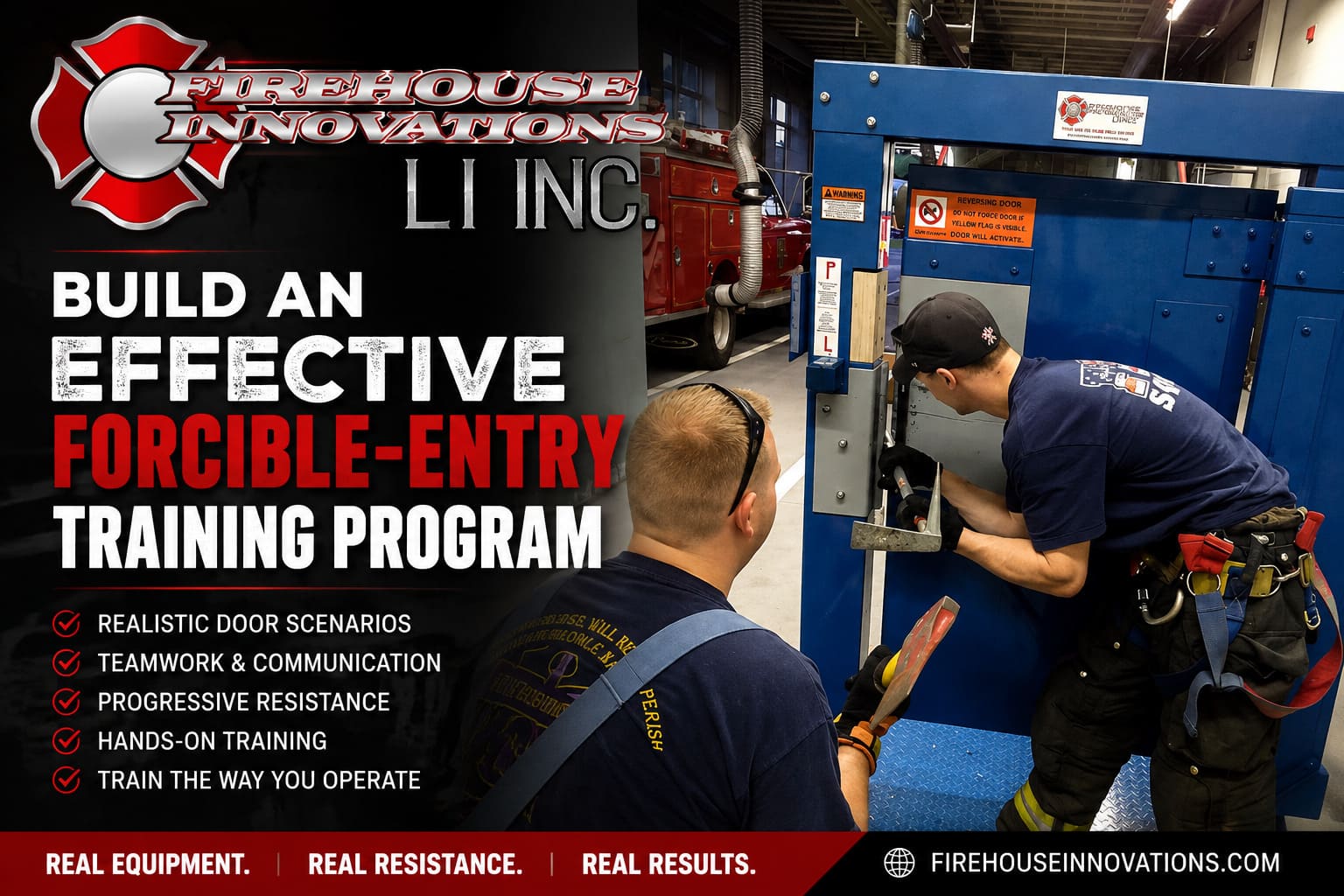
Forcible entry is one of the most important hands-on skills a firefighter can develop. When a crew arrives at a structure fire, medical emergency, alarm activation, or rescue incident, a locked or reinforced door can delay access to the building and prevent firefighters from reaching the people who need help.
Reading about forcible-entry techniques and watching demonstrations can provide a valuable foundation. However, firefighters develop confidence and proficiency through realistic hands-on practice.
An effective firefighter forcible-entry training program should expose members to different door types, tool positions, resistance levels, operating conditions, and team assignments. It should also give firefighters enough repetition to turn individual movements into reliable habits.
Here is how departments can build a practical, repeatable program that supports firefighter safety and operational readiness.
Begin With the Fundamentals
Before advancing to complex scenarios, instructors should confirm that every participant understands the basic principles of forcible entry.
Training should cover:
- Door construction and movement
- Inward-opening versus outward-opening doors
- Lock locations
- Hinge positions
- Door and jamb materials
- Tool selection
- Basic striking techniques
- Tool placement
- Communication between team members
- Maintaining control of the door
- Coordinating entry with the engine company
Firefighters should learn to evaluate the entire door before beginning to force it. A quick size-up can help the crew identify how the door swings, where it is secured, what type of frame surrounds it, and which tools may be most appropriate.
The goal is not simply to strike the door harder. The goal is to read the door, select a sound technique, place the tools correctly, and work as a coordinated team.
Train on More Than One Door Configuration
Real buildings do not contain only one type of door. Firefighters may encounter inward-opening residential doors, outward-opening commercial doors, reinforced apartment doors, rooftop bulkhead doors, wooden jambs, metal frames, angle-iron reinforcement, drop bars, and multiple locking points.
A training program that focuses on only one configuration can create a false sense of preparedness.
Firehouse Innovations designed the Multi-Force Door System to support multiple scenarios, including inward- and outward-opening doors, left- and right-hand swings, metal and wood jamb simulations, conventional tools, and hydraulic forcible-entry tools.
When firefighters repeatedly train on different door configurations, they become more comfortable adapting their technique instead of relying on one memorized movement.
Practice Both Left- and Right-Hand Swinging Doors
The direction in which a door swings affects tool position, striking angles, body placement, and how the firefighter approaches the jamb.
A firefighter who practices only from one side may become proficient with that movement while remaining uncomfortable on the opposite side. At an actual incident, the door will not necessarily match the firefighter’s stronger or more familiar position.
Departments should require members to practice:
- Working from the left side of the door
- Working from the right side
- Switching striking and tool positions
- Operating in confined spaces
- Performing the same skill with different partners
- Adjusting when the ideal position is unavailable
The Multi-Force Door System includes two swinging doors so firefighters can practice the different movements associated with left- and right-hand door configurations.
This balanced practice can help firefighters develop greater flexibility and confidence.
Use Progressive Resistance
Newer firefighters may benefit from beginning with lighter resistance so they can focus on technique, body mechanics, tool placement, and communication.
Once the movements become more consistent, instructors can increase the level of resistance. This challenges the team to maintain proper technique when the door does not open immediately.
Progressive resistance helps firefighters learn an important operational lesson: the first method may not always succeed.
Crews should be trained to recognize when they need to:
- Reposition the tool
- Increase the gap
- Change the striking angle
- Switch methods
- Use an alternate tool
- Communicate a revised plan
- Move from Plan A to Plan B
Firehouse Innovations’ training system allows resistance to be varied, helping instructors create different levels of difficulty and demonstrate that more than one forcing method may be required.
Emphasize Team Communication
Forcible entry is often performed by a two-person team. One firefighter controls and positions the Halligan or other entry tool, while the second firefighter operates the axe, maul, or striking tool.
Poor communication can reduce efficiency and create unnecessary risk.
Crews should practice clear verbal commands for:
- Tool placement
- Striking
- Stopping
- Repositioning
- Confirming a gap
- Setting the tool
- Forcing the door
- Controlling the opening
The firefighter holding the tool should communicate when the tool is ready to be struck. The striking firefighter should maintain control and avoid swinging until the command is understood.
Training should also address situations involving loud machinery, alarms, respiratory protection, limited visibility, and multiple companies operating nearby.
Add Full-Scenario Drills
Once firefighters demonstrate individual proficiency, the department can incorporate forcible entry into larger operational scenarios.
A realistic drill may include:
- Apparatus arrival
- Initial size-up
- Tool selection
- Hoseline deployment
- Door assessment
- Forcible entry
- Door control
- Search operations
- Firefighter removal
- Communication with command
Firehouse Innovations recommends incorporating its door system into search, firefighter-removal, and engine-company drills so members practice entry as part of a complete operation rather than as an isolated skill.
This type of integrated training reinforces the relationship between access, water application, search, rescue, and coordinated fireground operations.
Create a Train-the-Trainer Structure
A department should not depend on only one member to manage its entire forcible-entry program. Developing multiple qualified instructors creates consistency across shifts, companies, stations, and future recruit classes.
A Train-the-Trainer approach can help instructors learn:
- How to demonstrate each technique
- How to identify common mistakes
- How to safely supervise striking drills
- How to adjust resistance
- How to create progressive scenarios
- How to evaluate firefighter performance
- How to maintain training documentation
- How to coach without overwhelming participants
Firehouse Innovations offers Train-the-Trainer and full-department hands-on instruction using the Multi-Force Door System and additional props. Its training staff includes active and retired FDNY firefighters.
Make Repetition Part of the Schedule
Forcible entry should not be treated as an annual checkbox.
Skills involving tool placement, striking, balance, communication, and physical coordination can decline when they are not practiced regularly.
Departments can schedule short, focused sessions throughout the year. One month may emphasize inward-opening doors. Another may cover outward-opening commercial doors. Later sessions may address hydraulic tools, reinforced doors, or full-company operations.
Frequent short drills are often more effective than waiting for one large annual exercise.
Document Performance and Progress
Departments should record which members participated, which techniques were covered, what resistance was used, and where improvement is needed.
Instructors can evaluate:
- Accuracy of tool placement
- Number of strikes
- Time required to force the door
- Communication
- Body position
- Door control
- Ability to change techniques
- Team coordination
The purpose is not to turn every drill into a competition. Documentation helps instructors identify trends and plan future training.
Equip Firefighters for Realistic Practice
A successful program requires more than tools. It requires a training environment that allows firefighters to make mistakes, adjust their technique, repeat the movement, and try again.
The Multi-Force Door from Firehouse Innovations is designed to simulate multiple door conditions while allowing departments to repeat drills with replaceable resistance materials. More than 3,500 systems are reported in use, including systems in firehouses and training facilities.
Build Confidence Before the Emergency
Firefighters should encounter challenging doors during training—not for the first time during an emergency.
A structured forcible-entry program gives members opportunities to develop proper technique, communicate effectively, work from both sides of the door, and adapt when the first attempt does not work.
To learn more about the Multi-Force Door System or hands-on firefighter training, contact Firehouse Innovations at 631-390-9461 or request a quote through the company website.